

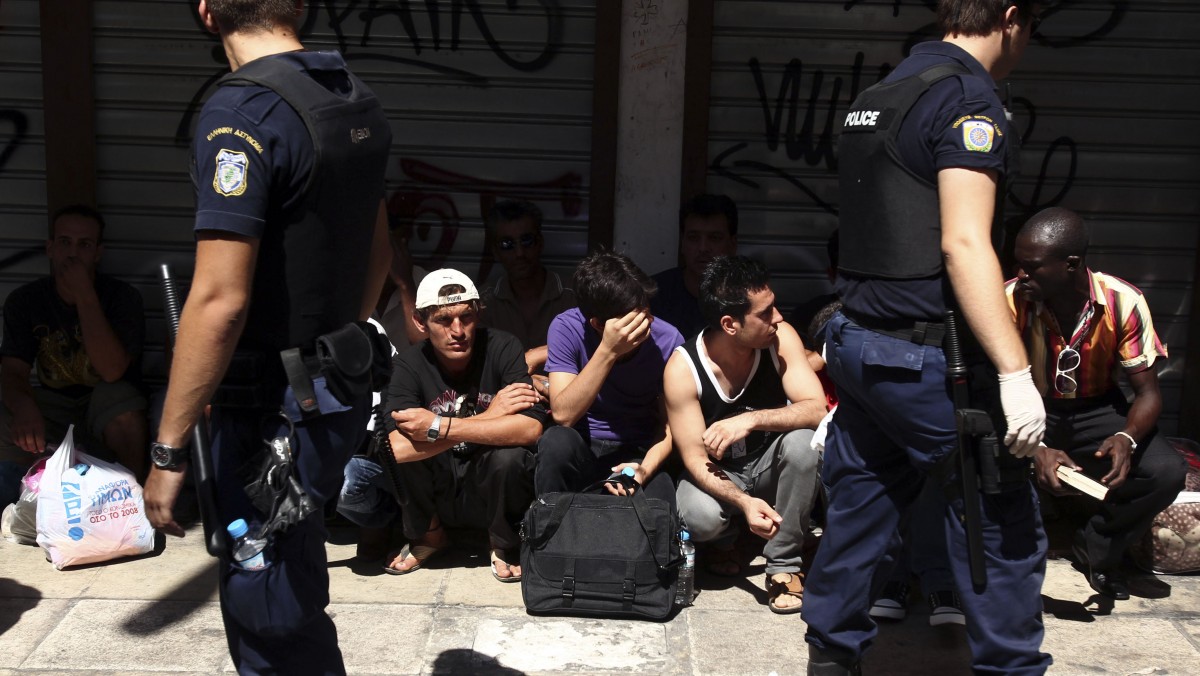
(BRUSSELS) — Two weeks ago, a 19-year-old Iraqi man died of stab wounds after being attacked by five men in Athens, Greece. Apparently the gang had attempted to attack a Moroccan and a Romanian but both managed to flee before the five men unleashed their brutality upon the Iraqi. Such attacks, that seem to be gaining ground in Greece, run parallel to the rise of Golden Dawn, Europe’s most recently successful far-right party that won 18 seats at Greece parliamentary elections last June. But Greece is far from being isolated.
In recent years, European far-right political parties have spread beyond established strongholds in France, Belgium, Italy and Austria to Hungary and Greece and even to the traditionally liberal Netherlands and Nordic countries. They have significant parliamentary seats in several countries. A widespread view is that the economic crisis and the austerity imposed on European countries explain the rise. But the evidence is unconvincing. First, a lot of these parties already existed before the crisis. Second, the countries in which there is most populism are not necessarily the ones that suffer most from the current austerity, Greece probably being the exception.
These parties actually show a repeated focus on immigration and more specifically on Muslim communities. They pretend to defend the national identity which they say is under threat from multiculturalism. In other words, these are issues that have nothing to do with the economic situation. The French Front National for example considers cultural identity of the French nation to be at stake because immigration is incompatible with the Muslim and African culture of the new immigrants. In Belgium, Vlaams Belang, or the “Flemish Interest,” has a slogan that says, “Our own people first.” In the Netherlands, the Freedom party’s leader, Islamophobe Geert Wilders, paints himself as a sort of freedom fighter against “extremist Muslims” who are against women’s rights and so on. In Finland, the Perussuomalaiset, or “True Finns” party says it wants to put the “true Finns first.” As for the Hungarian Jobbik, it focused its last campaign almost entirely on attacking the Roma population and proclaims that “Hungary belongs to the Hungarians.”
The message is clear; it is not so much about economic worries than about national culture and identity. Under the disguise of economic issues, all these parties see migration as a key opportunity to build greater support. This is not new. Back in 1993, Samuel Huntington felt that a coalition between Islam and Confucianism might challenge Western interests, values and power. But threats to security, he felt, come from the internal menace that immigrants from other civilizations supposedly represent to identity. His theory, although widely contested and criticized by other experts since, lent credibility to the racist theories of far-right parties.
If Europe cared genuinely about the values it claims to hold, statements such as the ones made by far-right parties about favoring one community over the other or pretending that one community as a whole represents a threat should be illegal or at least be considered as unacceptable. And politicians should be in the lead of the fight against prejudices. Reality is different though. Since the early days of the “war on terror,” it has become widely accepted to criticize Muslim communities under the guise of defending liberal values – from gender to freedom of speech. European mainstream parties have increasingly tapped into that discourse as well for fear of losing votes. And the media often contributes to disseminating it instead of questioning it. This shows a dangerous trivialization of racist discourses.
That “cultural narrative,” though, is based on a series of myths:
– Racists reject what seems different in order to affirm the superiority of the particular community to which they belong and so increase their own power. Islamophobia is based on the idea among some people – often amongst those who have little knowledge of what they are talking about – that they are superior to their Muslim peers. Affirming that European culture is at risk and threatened by others implicitly assumes that their model is better. There is a lack of coherence here: You can’t pretend to defend liberal values, freedom and rights and at the same time treat the others as if they were inferior. The way Europeans treat migrants shows that something has gone wrong with the values the claim to hold and defend.
– A lot of people feel their identity is linked to their culture. But culture is what relates you to a group; it is a set of characteristics that distinguishes its members from another group. It is what some have called a “collective programming” destined to give you some common rules to facilitate co-existence within a certain community. In other words, it is an adaptation to a certain environment. Cultural orientations, or habits and rules, are not who you are. Hence, considering that your identity can be challenged or threatened by other cultural orientations is a myth.
– Consequently, if cultural orientations are an adaptation to a given environment, they are not meant to remain fixed forever but rather in constant flux, always changing, developing and adapting themselves to new times and realities. Cultural orientations evolve with time; otherwise, we would still have the same ones as centuries ago.
On a more personal level, culture is a mold in which we are all cast, and it controls our daily life in many unsuspected ways, many of which are outside of awareness and therefore beyond our conscious control. We are completely unaware of this “collective programming” as long as the program is followed. The only time when we are aware of it is when things don’t follow the hidden program. Therefore, the great gift of intercultural encounters is to provide an opportunity to achieve awareness of the functioning of one’s own system. Far from being a menace, it is actually one of the most effective ways to learn about oneself.
– On the basis of that definition, “culture is a set of rules that links you to a group,” culture is not only about ethnic factors or religion. There are other cultures based on gender, business, organizations, social area … An Egyptian or an American can be a democrat or an authoritarian, a pacifist religious believer or an atheist political radical; a Moroccan or an Italian can be a liberal or an extremist, tolerant of others or intolerant. It is wrong to imprison any human being inside the straitjacket of a single defining culture. Cultures are not isolated separated spheres. They overlap. No one can claim to belong exclusively to one culture. We are the product of many cultures. Hence, cultural uniformity is a fallacy propagated by far-right racist parties for their own political benefit. And the concept of the nation-state, i.e., the idea that there is a link between a certain community and a given territory is itself a political creation that has no basis in the history of mankind. People of all times have always moved and mixed.
– We have this tendency to perceive the values of our culture in moral terms and therefore to view other people’s values as morally inferior. We have to realize that ours is just one culture, with no claim to moral superiority. If culture is meant to be an adaptation to a certain group, they don’t have an intrinsic value: They are not either good or bad. Each cultural orientation has its own merits. Some simply better fit a situation than others.
It is time to consider diversity in colors and languages and habits and traditions as a source of strength and mutual enrichment. It is time to start thinking about what we have in common instead of what might separate us. We are one single human family. We need a hospitality based on the recognition of an intrinsically similar other. And we have a collective responsibility to uphold the principles of human dignity and equality at the global level.