

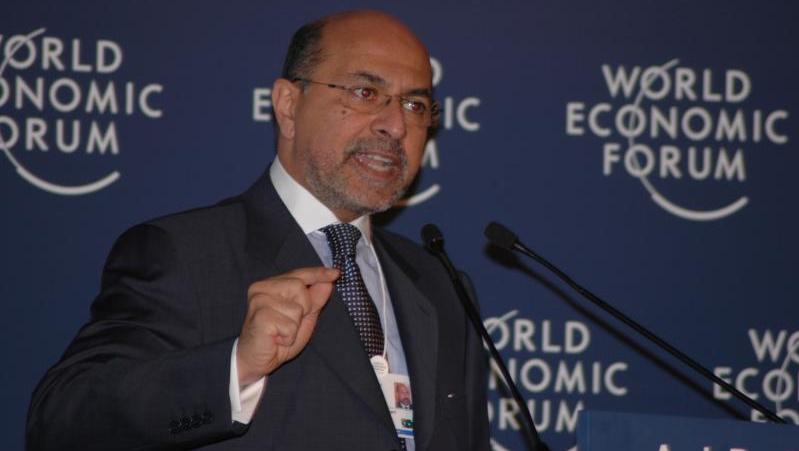
Egypt’s top tycoon, Shafik Gabr, the chairman of the ARTOC Group for Investment and Development, was one of the first of that country’s business leaders to voice his concerns about the violent upheaval that led to the overthrow of former strongman Hosni Mubarak, and today he has similar fears about what is going on in Syria.
In February 2011, shortly after the start of the Arab Spring, Gabr said, “I am a person who has always believed in the importance of orderly transition with law and order, because the minute you lose law and order is the minute you enter into a dark tunnel, a vicious circle.”
Now, he tells MintPress News in an exclusive interview, “I have very significant concerns about what’s happening in Syria because my hope as a human being is we would be able to resolve issues without getting into situations like what happened in Libya. I’m not a politician and therefore I sometimes fail to see how we would accept such collateral damage.”
The United Nations has deplored the failure of diplomacy to end the conflict between the regime of President Bashar al-Assad and opposition forces, which has reportedly claimed more than 21,000 lives in nearly 17 months.
“As a businessman, when I invest, I want to make sure my risk portfolio is known,” continues Gabr. “I sometimes ask friends of mine in politics which is better, the devil you know or the devil you don’t know.
“And with what’s happening in Syria, unfortunately there are so many unknowns. Every day we’re learning about players that are involved that are not transparent. Therefore the outcome could be very much worse than what’s going on,” he asserts.
When asked about the possibility that the rebellion could be hijacked by al-Qaida, Gabr responds emphatically, “Definitely. And those are the ones we know. There may be others we don’t know about.
“And what happens in Syria doesn’t end up just impacting Syria,” he adds. “What happens in Syria will impact its neighbors. A country like Jordan, which is stable and has a good monarchy, will be impacted by what happens in Syria. Lebanon as well. The mosaic needs to be really looked at very carefully, and my concern is that is not being dealt with at all.”
Reformist pioneer
Gabr, who has degrees in business and economics from Cairo’s American University and the University of London, was one of the founders of the Arab Business Council in 2003.
Initially part of the World Economic Forum before splitting off in 2007, the Council was comprised of business leaders and CEOs from 16 different Arab countries working to achieve critical reforms and greater competitiveness in the region.
“The ABC believes that, for the Middle East to integrate globally, regional governments need to reform their policies, open up to their neighbors, enhance transparency and accountability and work on a sequential, serious and sustainable program of change,” Gabr explained at the time.
Ultimately, the council failed. “What we tried to do back then was to work responsibly with governments and try to work with political, social and economic reform. And there was push back,” he acknowledges.
“Some countries were more receptive than others, but there was definitely push back, and some of it even came from the business community itself, from those who did not want to shake the existing infrastructure,” he says. “So it was difficult, but a worthwhile effort. I learned a lot from it. My friends and colleagues did, too.
“But we did at least raise the voice of the business community,” adds Gabr, “and we put major markers on the ground in terms of what needs to happen.”
Verdict on the Arab Spring
As for whether the events of the Arab Spring have succeeded in achieving those goals, Gabr says the jury is still out. “In my sense, we are in a period of transition,” he asserts. “None of the countries that have experienced the uprisings that have taken place have stabilized yet. And therefore it’s a little bit early to see if we are moving in the right direction.”
“If you look at a country like Libya, they just recently had an election but there is still no functioning government,” he says. “In Egypt, even after the presidential election there is no cabinet in place. So I cannot really say whether this transition is going to succeed or not.
“But there is no doubt in my mind that there’s no going back. And that we need to move forward and make sure we can build institutions that can safeguard democracy and make it sustainable,” maintains Gabr. “Democracy requires institutions. It took a number of years for the U.S. to get where it is, and Western Europe as well. We are in the very early stages of doing that.
“My hope for Egyptians,” he adds, “is that the institutions are in place so that the checks and balances also play themselves out. Otherwise we may end up ending one state of affairs and having one that is not any better.”
Foundation for the future
Gabr, who is Egypt’s premier collector of Orientalist art and Chairman of the Mohamed Shafik Gabr Foundation, which supports local initiatives promoting social welfare and development, is now launching a new peace initiative — a foundation in the United States designed to create an East-West dialogue.
“We are inviting young Americans to Egypt and my part of the world and vice versa,” he explains. “We will have specific programs designed for their areas of interest, to work with their counterparts and to have deliverables in the sense of building communication and understanding, which I think is very important.”
“Regardless of how much certain dictators did, I don’t think that it makes sense that we lose the lives of innocent people in order to change the regime. There’s got to be a different way,” Gabr contends.
“Why can’t we talk to the Syrian leadership in a manner that can produce results rather than having armed rebels who are still going to kill innocent people,” he posits. “I would have hoped we can find conflict resolution systems that do not end up in the manner that we’re witnessing right now.”
As for what reforms Gabr believes are needed to leverage the culture and heritage of the Middle East, and in particular Egypt, going forward, he says, “We definitely need to have a modern civil constitution that protects all people, creates a political system of checks and balances and maintains an independent judiciary. Being able to achieve those would I think be the pillars for everything we can build on.”
This is Part Two of a MintPress exclusive interview with Shafik Gabr. To read Part One, click here.
Feature photo | Shafik Gabr sits during an interview. Gabr, a businessman and reformer, is trying to build connections between the people of Egypt and the United States. (Photo by the World Economic Forum via Flikr)