


(MintPress)— President Obama met with Israeli prime minister Benjamin Netanyahu on Monday, just as pressures for the U.S. to go to war with Iran were mounting. However some within the U.S. government are hoping to avert a war with the Islamic Republic.
In addition to Israel’s top official, the American Israel Public Affairs Committee (AIPAC) , the largest U.S. pro-Israel lobby, the U.S. president’s prospective Republican rivals and the U.S. Senate (32 of whose members are currently co-sponsoring a non-binding resolution asking the administration to bring its Iranian policy fully in line with Israel’s) are all calling upon the Obama administration to take a hard-lined approach to dealing with Iran.
Iran’s Agenda In Question
The groups listed above are pressing for U.S. military action against Iran’s nuclear program, and accuse Iran of secretly developing a nuclear weapons program under the guise of its civilian atomic energy program. Iran has stated it is not developing weapons, and that its nuclear program does not aim to produce reactor fuel or material for nuclear warheads.
However, “it is impossible to know the full extent of Iranian intentions. American spy agencies are wary about drawing any categorical conclusions after an embarrassing intelligence lapse that led to erroneous accusations of Iraqi nuclear arms work, which the Bush administration used to help justify the 2003 US-led invasion that toppled Saddam Hussein,” The Times of India points out.
A report from AlArabiya recently stated that many within the Middle East believe Israel is trying “to drag a reluctant United States into confrontation with Tehran because it could not inflict sufficient losses on Iran alone.”
Obama’s Take
While Obama is asking Israel to hold off on attacking Iran’s nuclear sites, allowing time for sanctions and diplomacy, he also vowed in a speech on Sunday to AIPAC he’d use all “elements of American power” – to prevent the Islamic Republic from building an atomic bomb.
Obama said that “as President and Commander-in-Chief, I have a deeply-held preference for peace over war. I have sent men and women into harm’s way. I have seen the consequences of those decisions in the eyes of those I meet who have come back gravely wounded, and the absence of those who don’t make it home. Long after I leave this office, I will remember those moments as the most searing of my presidency. For this reason, as part of my solemn obligation to the American people, I only use force when the time and circumstances demand it. And I know that Israeli leaders also know all too well the costs and consequences of war, even as they recognize their obligation to defend their country. We all prefer to resolve this issue diplomatically.”
Foreign policy expert Robert Naiman, in a recent column argues, “Largely missing from the recent political debate, until now, has been a full-throated defence of diplomatic engagement with Iran towards negotiated agreements that would resolve or mitigate international concerns about its disputed nuclear programme, thereby pushing back the prospect of military confrontation.”
Voices of Dissent
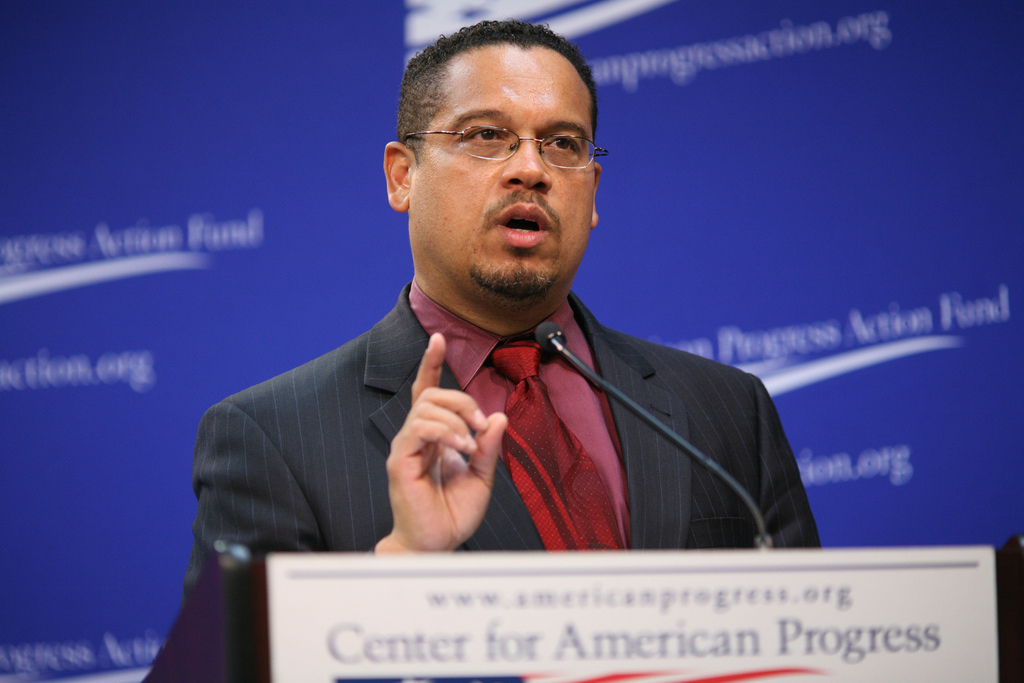
However, there have been members of Congress who have tried to silence the beating of the war drums in recent weeks. The vocal cries, often less touted by mainstream media, of figures like US Representatives Keith Ellison [D-MN] and Walter Jones [R-NC] are currently circulating a Congressional letter to President Obama asking him to redouble US efforts towards a diplomatic agreement with Iran.
Keith Ellison became the first Muslim to be elected to the United States Congress. He is also the first African American elected to the House from Minnesota.
Walter Jones garnered international media attention in 2003 when he led the Congressional move to rename “French fries” in the House cafeteria to “freedom fries” in protest over French opposition to the US invasion of Iraq.
In the letter authored by Jones and Ellison, the duo points out that now that the “international community has enacted the strongest sanctions against Iran to date” the redoubling of diplomatic efforts to “ensure Iran’s nuclear program remains a civilian one” are needed.
Jones and Ellison charge that “without a corresponding diplomatic undertaking, pressure alone could lead to unintended and potentially devastating consequences, including war. Top U.S. national security officials have said that a military strike against Iran could lead to a regional war in the Middle East and attacks against U.S. interests.”
While a desire to “prevent another costly war in the Middle East” is cited as impetus for the letter, the authors say that they “hold no illusions about the abuses of the Iranian regime and are well aware that it rejected your previous diplomatic overtures.”
However, Jones and Ellison say they “agree with most Americans that the United States should not enter a new war, just as we are finally ending two others.”
The letter also acknowledges that while “progress will be difficult” in the situation with Iran, the importance of “keeping diplomatic channels open is the best way to avoid a new war and ensure that Iran does not gain a nuclear weapon.”
In addition to Jones and Ellison, 35 other members of Congress have signed their names in support of the action.
And the American public seems to be thinking along the same lines.
A recent column for the New York Times recalled that the “United States has now endured what by some measures is the longest period of war in its history, with more than 6,300 American troops killed and 46,000 wounded in Iraq and Afghanistan and the ultimate costs estimated at $3 trillion. Both wars lasted far longer than predicted. The outcomes seem disappointing and uncertain.”
Harvard University’s Graham Allison, a leading expert on nuclear strategy is also mentioned in the article, for his comparison of the evolving conflict over Iran’s nuclear program to a “slow-motion Cuban missile crisis.” Allison says that hallmarks of the events include each side possessing murky intelligence, and cautions that when tempers run high, “there is the danger of a devastating outcome.”
Experts Critique Coverage on Iran
Scott Shane, author of the Times’ column, wonders why the beating of the war drum can be heard so loudly if current polls reveal that after 10 years of war, the American public is weary of it.
Still, Naiman lauded Jones and Ellison’s move, and criticizes the media for sensationalizing the call to war, and failing to educate the public about the issue. “Major media are often ambivalent about the degree to which it’s really their responsibility to educate the public about basic facts — like the fact that the U.S. government is quite confident that Iran is not now trying to build a nuclear weapon.”
Naiman also says that presenting accurate, balanced coverage of the issue and “strongly and consistently challenging some of the core assumptions of the pro-war voices” should be the mission of the media.
“How can it be, less than a decade after the U.S. invaded Iraq, that the Iran debate is breaking down along largely the same lines, and the people who were manifestly, painfully wrong about that war are driving the debate this time as well?” Peter Beinart, professor of journalism and political science, recently mused, “ Culturally, it’s a fascinating question—and too depressing for words.”