


Update | By Martin Michaels
On Monday, during Russian President Vladimir Putin’s three day visit to Beijing, Chinese government representatives announced that both Russia and China were playing a “positive role” in helping to mediate the ongoing conflict in Syria. Liu Weimin, a Chinese Foreign Ministry official, made clear that both countries oppose foreign intervention in Syria, saying, “Both sides oppose external intervention in Syria and oppose regime change by force.”
However, Weimin also stressed Chinese and Russian commitments to begin political dialogue as soon as possible, as a means to reconcile the violent conflict in Syria. Both countries have previously exercised veto power at the UN, blocking resolutions that call for sanctions and Bashar Al-Assad’s removal.
(Mint Press)— In perhaps the most brazen statement on the Syria conflict, Secretary of State Hillary Clinton openly supported the removal of embattled Syrian President Bashar Al-Assad during a press conference Sunday. In the 15-month uprising conflict that has claimed more than 10,000 lives and displaced 200,000, according to UN estimates, waning support for the transitional Kofi Annan peace plan could signal a more direct, military intervention by Western powers.
Libya-style intervention
While visiting Stockholm, Sweden last week, Secretary of State, Hillary Clinton told reporters, “Assad’s departure does not have to be a precondition, but it should be an outcome,” when speaking about the ongoing conflict in Syria. Previously, U.S. officials have condemned the crackdown against anti-government protesters, but stopped short of calling for the direct removal of regime officials.
The rapidly deteriorating security situation has been underscored by a warning from former UN Secretary General Kofi Annan. Commenting on the dire situation in an Arab league meeting in Doha, Qatar, Annan warned quorum members saying, “The spectre of all-out civil war, with a worrying sectarian dimension, grows by the day.”
The moribund six-point Annan peace plan for a de-escalation of the conflict was dealt a final blow Monday when the Free Syria Army, one of the main armed opposition groups, made a public statement indicating that they no longer support the UN-backed plan. The window for finding a political solution has been significantly hindered, not just by rebel intransigence, but by continued government crackdowns on protesters.
Houla massacre
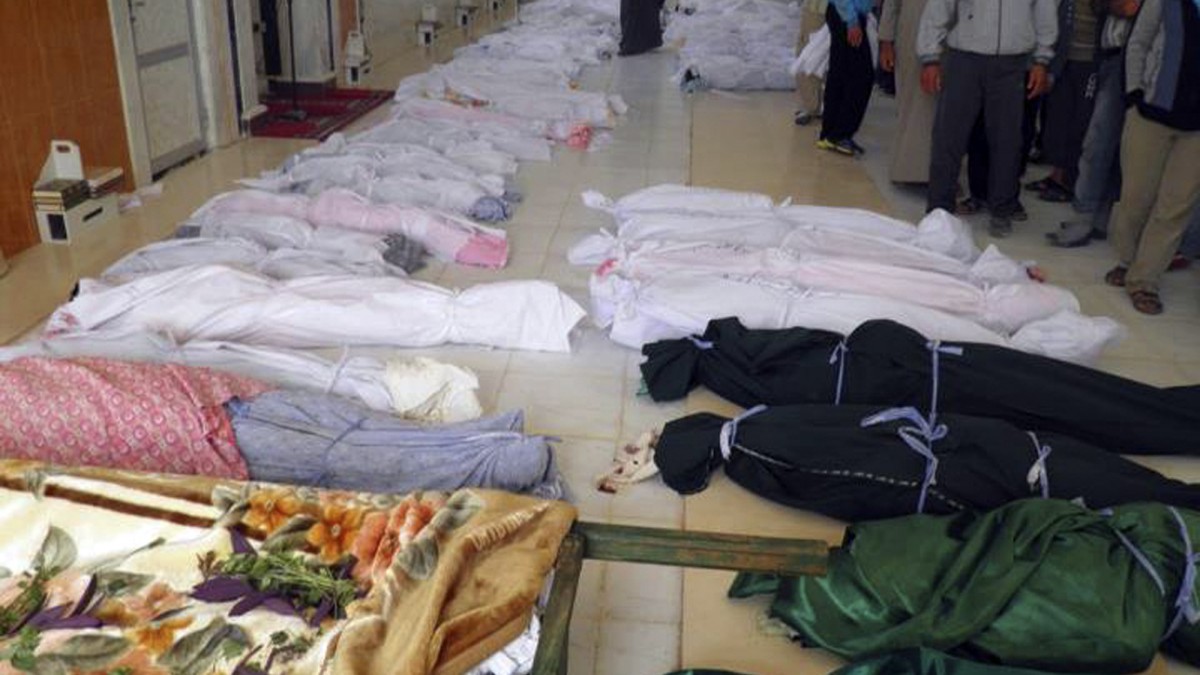
On May 25, a massacre in the Syrian town of Houla left 108 civilians dead, shocking the international community and drawing sharp condemnation from diplomats. The rebukes came, not just because of the continued killing, but also because many among the dead were women and children. The killings were carried out execution style, with most victims shot at point-blank range. Survivors and eyewitnesses blame the shabbiha militia, a group loyal to the current regime.
While activists blame the loyalists for the massacre, Syrian President Bashar Al-Assad expressed disgust, claiming the acts were carried out by foreign enemies.
“If we don’t feel the pain that squeezes our hearts, as I feel it, for the cruel scenes – especially the children – then we are not human beings,” Assad said in his first public address since January of this year.
While many are quick to condemn the Houla massacre as another brutal government crackdown, others, including former Pentagon official Michael Maloof, are more skeptical. In a recent statement with Russia Today, Maloof claims the details of the Houla massacre show the signs of al-Qaeda, adding to the skepticism held by some who contend that terrorists have infiltrated the ranks of otherwise peaceful protesters.
For many, the massacres bare an unfortunate resemblance to the Srebrenica massacre during the Bosnian War in 1995. This, as Kofi Annan contends, is a “tipping point”, much the same as when the United States chose to intervene militarily in Bosnia.
CNN reporter Christiane Amanpour shared this sentiment in a recent statement, saying, “We’ve been there before. We’ve been there in Bosnia. We’ve been there in Rwanda. We’ve been there for the last several decades. And this kind of depravity, frankly – gross violation of international humanitarian law – demands under the law a response.”
The Srebrenica massacre, what is declared a genocidal act by some, occurred in the summer of 1995, when some 8,000 Muslim men and boys were killed by Bosnian Serbs in the worst massacre to take place in Europe since WWII.
Lawmakers in the United States, particularly those who previously supported military intervention as a means to further regime change in Libya and Iraq, have voiced support for the U.S. to offer arms and military support to the Syrian opposition.
Arming the opposition
In a May 31 meeting with Malaysian premier Najib Tun Razak, U.S. Senators John McCain (R-AZ) and Joseph Lieberman (I-CT) announced support for arming the Syrian opposition. This is consistent with earlier statements on Libya in which the senators supported a similar action.
“It’s time to act. It’s time to give the Syrian opposition the weapons in order to defend themselves. It’s not a fair fight,” said McCain in the Malaysian capital of Kuala Lumpur.
Russia and Iran, two of Bashar Al-Assad’s staunchest allies have been aiding the regime with arms and diplomatic support throughout the uprising. However, the Obama administration has not made clear, public plans to arm the Syrian opposition.
Previous reports indicate that France and the United States have been arming the rebels covertly. In February 2012, a statement by a rebel claiming to represent the Free Syria Army told journalists, “French and American assistance has reached us and is with us.” When asked to elaborate on the nature of the assistance he added, “We now have weapons and anti-aircraft missiles and, God willing, with all of that we will defeat Bashar [President Assad].”
Although the U.S. has previously used military force unilaterally without UN permission, vetoes and delays by the security council have hindered the ability for a coordinated military style intervention, as supported by some within the American government.
John McCain continued saying, “It is shameful that the United Nations Security Council should again be hindered by Russia and China, by their vetoes for any significant action against Syria.” Previous efforts by China and Russia have delayed a coordinated international response to the conflict in Syria.
Boasting a strong arms trade, Russian sales to Syria surged to over $4 billion dollars in 2010. Russian doubts, however, extended further with officials expressing concern about the rise of an armed terrorist insurgency earlier this year. Speaking about a Russian veto of a UN resolution, Russian Foreign Minister Sergey Lavrov said in a public statement in February, “Such measures were described in great detail but only for one side – for the [Syrian] government side. We submitted several amendments in order to eliminate this imbalance and describe concrete steps that we expect from the opposition and the international community concerning armed extremists in Syria.”
Despite the reservations expressed by Russia, China and others, recent reports indicate that the U.K. has plans to set up camps inside Syria. The camps along the borders with Lebanon, Turkey and Jordan are said to be set up to provide humanitarian assistance to refugees fleeing. However, reports indicate that the camps are designed to help rebels should a civil war break out in Syria.
While reports differ on this issue, the Israeli intelligence news agency, Debkafile, reports that British soldiers and M16 intelligence officers are already inside Syria providing arms and support to the rebels.
While the flow of illegal arms and money has already been supplied by gulf countries Saudi Arabia and Qatar, among others, Western countries have been hesitant to lend such strong support to rebels. U.S. ambassador to the UN Susan Rice retreated from earlier statements when urging members of the international community to, “consider whether they are prepared to take actions outside of the Annan plan and the authority of this [UN Security] Council.”
While the impassioned appeal may resonate with some, U.S. ambassador Ivo Daalder believes there are a specific set of conditions under which such an intervention can take place. Comparing the situation to Libya, Daalder enumerated the three points required for U.S. action: a “demonstrable need” to intervene, support from nations in the region and a UN Security Council mandate.