

The biggest gas deal in history to deliver fuel from the Caspian coast off of Azerbaijan, through Georgia, Turkey, Greece, Albania, Bulgaria and into Italy, is fast approaching reality. The $45-billion project requires the collaboration of seven countries, 11 investment companies and 11 buyers, according to Joe Murphy, vice president of the Southern Corridor region at BP, based in Baku, Azerbaijan.
Strategically, the project has incorporated petrochemical companies from England, Norway, Turkey and Azerbaijan, as well as Iran and Russia, among others, to maintain geopolitical stability, Murphy explained at a panel at Georgetown University, titled “Southern Gas Corridor: Implications for European Security.”
He said that gas from Azerbaijan “has already been sold to the 11 buyers for the next 25 years.” A BP document says that those sales are worth $100 billion. The project is being touted as the next “contract of the century,” following a deal signed in 1994 between Azerbaijan and international companies.
The project has been lauded in the United States for its ability to circumvent Russia and bring gas into Europe. However, one of the main strategic partners in the development of the pipeline is Lukoil, Russia’s second largest oil company following Rosneft.
Another interesting aspect of the project is its inclusion of Naftiran Intertrade Company Sàrl (NICO), a Swiss-based subsidiary of the National Iranian Oil Company. The Southern Gas Corridor project has given NICO a 10 percent share in the deal and anticipates future collaboration with Iran.
Azerbaijan is being praised for its diplomatic balancing act with the Southern Gas Corridor project, reaching out to Europe while also maintaining good relations with both Russia and Iran. But its peculiar position geographically and geopolitically also allows it to curb American aspirations for its political future, according to Global Risks Insight, a website focused on political risk around the world.
“American foreign policy would like nothing better than to exert greater control in Azerbaijan,” an analyst writing on the site asserted. “Ironically, the Russian and Iranian presence serves helps Azerbaijan by serving as a deterrent to more aggressive U.S. meddling in the region. The last thing Russia would accept is a Western-backed revolution in Azerbaijan, tilting the balance power.”
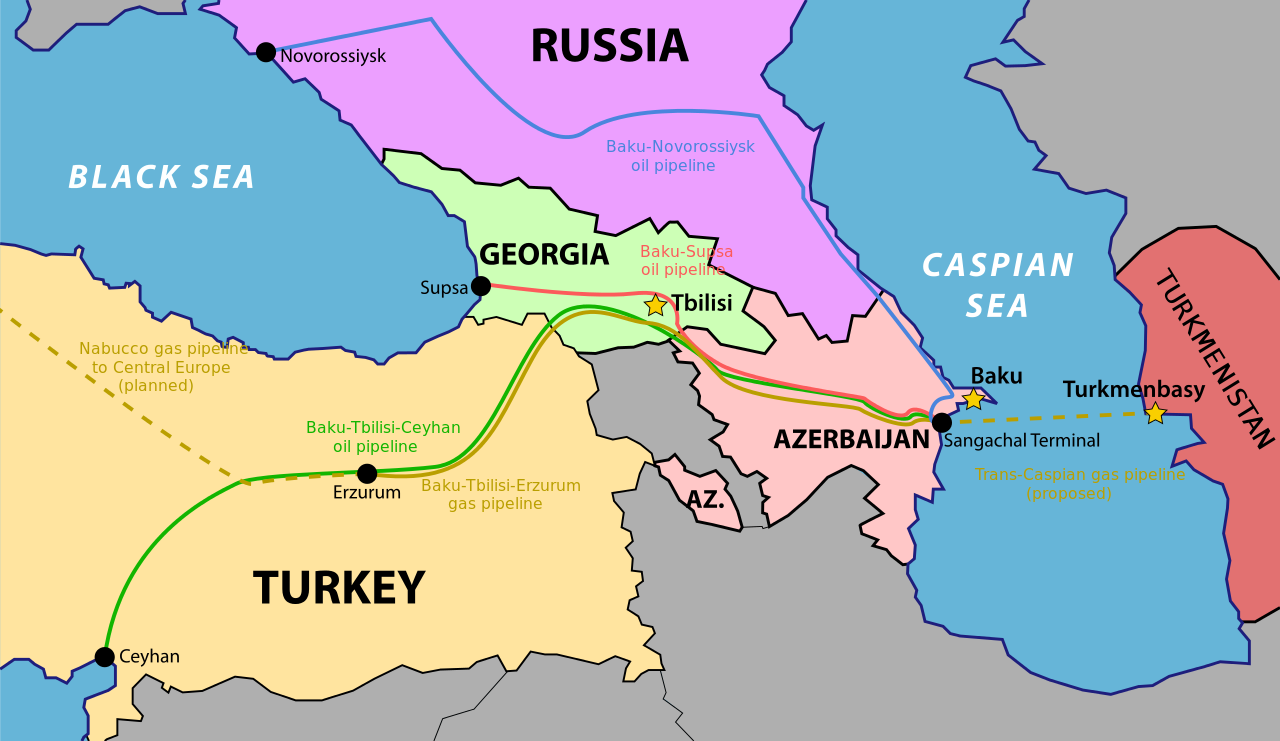
The project, due to be finished by January 2020, still has many hurdles to clear, including establishing contracts with and compensating up to 55,000 landowners and land users in the European section alone, said Michael Hoffman, external affairs director of the Trans Adriatic Pipeline, who also spoke on the Georgetown panel.
Another issue is that the gas has already “been committed for a period of 25 years” to Bulgaria, Greece and Italy, Hoffman continued. Thus, for other countries seeking to take advantage of the pipeline, it can act as a conduit for those commercial interests, but they will have to find another gas source.
Azerbaijan has 31 trillion cubic feet of proven natural gas reserves, while Iran, with the world’s largest, has 1,192.9 trillion cubic feet, according to BP’s 2014 Statistical Review of World Energy.