

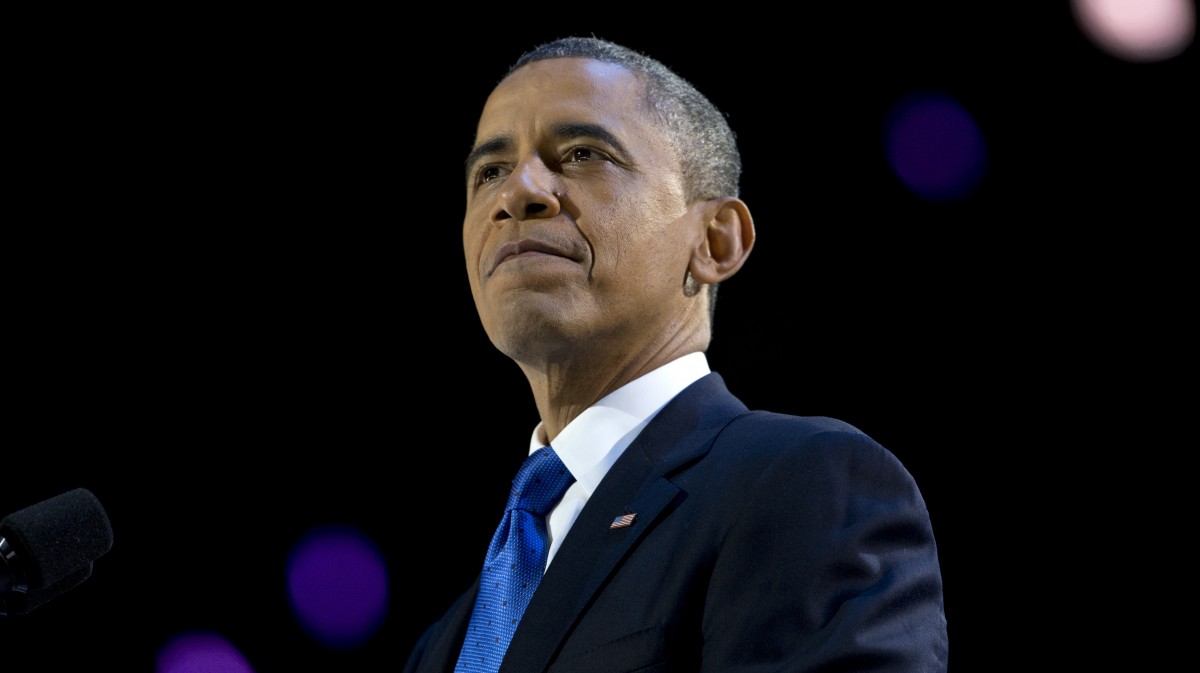
In an interview published Sunday by the New Yorker, President Obama said pot is no more dangerous than alcohol — and that marijuana legalization in Colorado and Washington state is an “important” move towards a more just legal system.
“I smoked pot as a kid, and I view it as a bad habit and a vice, not very different from the cigarettes that I smoked as a young person up through a big chunk of my adult life,” Obama told reporter David Remnick. “I don’t think it is more dangerous than alcohol.” In fact, the president went on to admit pot was actually less dangerous “in terms of its impact on the individual consumer.”
Obama also dived into the vastly disproportionate effect marijuana arrests and incarcerations have on non-white Americans. “Middle-class kids don’t get locked up for smoking pot, and poor kids do,” he said. “And African-American kids and Latino kids are more likely to be poor and less likely to have the resources and the support to avoid unduly harsh penalties.”
Last year, the American Civil Liberties Union issued a report that found African Americans are four times as likely as whites to be arrested for marijuana, even though both groups use the drug at similar rates. (In Washington, D.C. specifically, African Americans are eight times more likely to be arrested.) This is not an abstraction. Under federal law and in most states, marijuana offenses go on a person’s criminal record and carry jail time. That can make it harder if not impossible to find a job or to vote and often results in the revocation of professional licenses, the loss of education, financial aid or public benefits, and can event prevent a person from adopting a child. More people are arrested for marijuana-related offenses than for violent crime, meaning police resources are sucked away from addressing the latter.
The disproportionate effect of marijuana arrests and prosecutions on minorities is also part and parcel of the disproportionate damage the criminal justice system as a whole inflicts on these communities. Imprisoning massive portions of the country’s black and latino populations breaks up families, frays communities, destroys economic opportunity, and undermines those communities’ faith in the democratic process — leading to falling levels of political and voter participation.
Recently, U.S. Attorney General Holder took steps to relax federal prosecution of marijuana offenses, by averting mandatory minimums and by avoiding prosecution of marijuana users who are complying with state law. “Too many Americans go to too many prisons for far too long, and for no truly good law enforcement reason,” Holder said.
The significance of the recreational marijuana laws in Colorado and Washington state is that they not only remove criminal penalties for possession — at this point, 17 states and many cities have passed decriminalization measures — they also legalize or regulate distribution and growth. Legalization supporters view that latter step as critical to driving out the black market and controlling the health consequences of marijuana consumption.
In the interview, Obama also worried that legalization of marijuana could be used to eventually build a case for legalizing harder drugs as well. “The experiment that’s going to be taking place in Colorado and Washington is going to be, I think, a challenge,” Obama said. “I also think that, when it comes to harder drugs, the harm done to the user is profound and the social costs are profound. And you do start getting into some difficult line-drawing issues.”
This material was published by the Center for American Progress Action.