

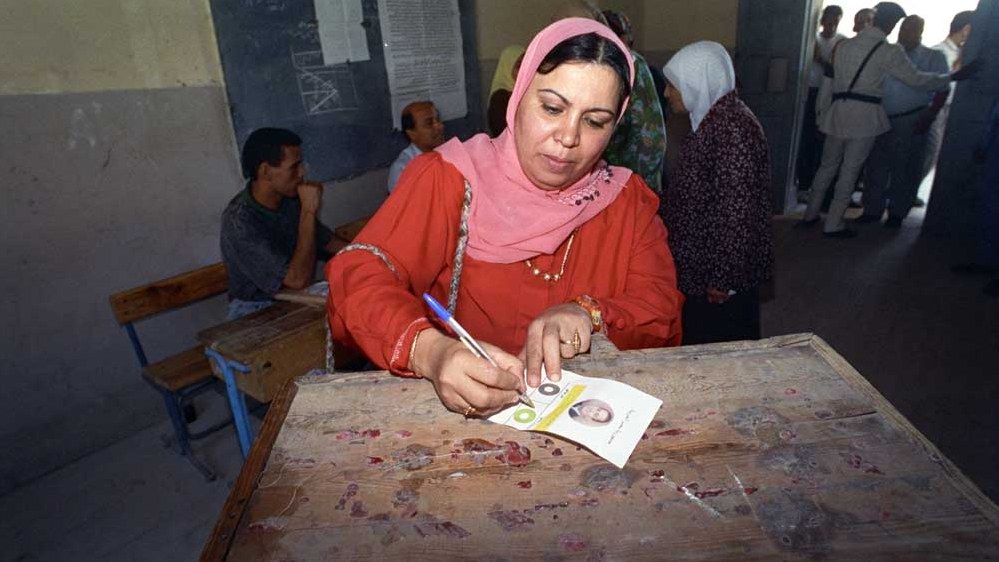

(MINNEAPOLIS) – Egypt is supposed to hold the nation’s first free and fair presidential election at the end of this month. It will be the second time in Egyptian history that more than one candidate will be vying for the highest office. The last time there was more than one contender, was in 2005 when Ayman Nour, a parliamentarian, vowed to unseat the incumbent president Hosni Mubarak. In the end Mubarak won easily with 88.6 percent of the vote in an election that was widely seen as flawed. The challenger, Ayman Nour ended up with a five-year prison sentence for supposedly “forging powers of attorney” when creating his own political party, El-Ghad. After serving three years in prison, he was released.
Until now, both parliamentarian and presidential elections in Egypt have been predictable with the ruling party always dominating both the upper and lower houses of parliament. The government’s attempts at being democratic and transparent are farcical at best. Over the past three decades I have covered numerous parliamentary elections and referendums and rarely has there been any surprise in the outcome.

Egypt’s first parliamentary elections were held in 1866, but it wouldn’t be until 110 years later that Egyptians would experience their first multiparty elections. In 1976, under President Anwar Sadat, Egyptians went to the polls for the very first time to elect candidates running from opposing political parties. Even though they were considered to be the opposition, in retrospect one could hardly call them that because both parties were under the umbrella of the governing Arab Socialist Union party. In the end, both the “opposition” parties managed to secure a token number of seats. Unfortunately, Egypt’s experiment with multiparty democracy was short lived. Sadat pulled the plug on the 1976 assembly after an increasing number of MPs expressed their opposition to the 1979 peace treaty with Israel.
The 1984 and 1987 elections were considered to be the most fair and open with the greatest political diversity. In 1987 the opposition, which included candidates backed by the Islamists, won just over 100 seats in the 458-seat assembly. This did not in any way threaten Mubarak’s ruling National Democratic Party (NDP) grip on power, but it did allow more voices to be heard, including the banned Muslim brotherhood, for the very first time. Because there was greater representation in these elections, there were numerous incidents where opposing parties clashed. I remember driving into the Nile Delta town of El Rhoda and seeing riot police breaking up fights between rival gangs from opposing parties. It was there that an Egyptian colleague and I were taken in by the police and interrogated for a few hours after witnessing the clashes.
The 1987 elections were a landmark of sorts because never before had the opposition secured so many seats. Unfortunately, the honeymoon was short lived. The Supreme Constitutional Court ruled that some of the independent candidates did not fulfill certain requirements. Hence the assembly never completed its full term.
The 1990 elections were boycotted by most of the opposition who were enraged over having to give up their newly acquired seats when the assembly was suspended.
In 1993, the Parliament unanimously nominated Mubarak for a third six-year term. As was the practice in Egypt, the people were then asked to cast their ballots agreeing or disagreeing with the parliaments decision. I remember going through the streets of Cairo during such referendums and looking up at all the posters and placards calling for a “yes” vote for Mubarak. Basically a lot of hoopla for nothing!
The opposition participated in the 1995 parliamentary elections, but the entire process was marred with voter intimidation, stuffing of ballot boxes and arbitrary arrests of opposition candidates. The violence was so prevalent between rival parties that around 80 people died across the country and over 1500 were left injured. The government’s slogan for the election was, “A vote for the National Democratic Party is a vote for Mubarak.” In the end, the opposition performed poorly and Mubarak’s NDP party and their allies continued their monopoly over the assembly.
Unfortunately, elections in Egypt were never without controversy. Arrests, ballot stuffing and voter intimidation was the norm. I can’t recall how many times I was at a polling station when all of a sudden out of nowhere a half dozen buses would appear full of people, who were obviously not from the area. They would be escorted into the polling center, under the watchful gaze of some authoritarian figure, told to cast their ballot and then escorted back out to the buses. The practice was so widespread that the average voter just learned to accept it as part of the “democratic” process.
Opposition candidates and their supports would routinely come under attack from government thugs, or Bultigaya as they were commonly known. Basically, the government would release common criminals during the election season and use them to disrupt poling stations located in neighborhoods where the opposition, particularly the Islamist candidates, were seen as strong contenders.

On one occasion, during the 2000 parliamentary elections while I was covering the then spokesman for the Muslim Brotherhood, Mamoun el Hodaibi (he became the Brotherhood leader in 2004), got word that there was trouble at one of the polling stations. Hodaibi and a bunch of his supporters piled into cars and we headed to the polling station in question. When we got there, riot police had surrounded the entire building. People were still allowed entry, but the atmosphere was very tense. I followed Hodaibi and his supporters inside and while he was questioning some of the electoral staff, we got word to expect trouble when we stepped back outside. At the time I didn’t believe that I was in any danger so I continued to follow as they exited the building. Suddenly out of no where a group of women and men wielding long knives, separated me from Hodabi’s group, ripped all my camera equipment off my shoulders and proceeded to smash them into pieces right in front of the riot police, who pretended to look the other way. When it was all done, there were broken pieces of cameras and lenses scattered everywhere. Then out of the blue, a small group of teens arrived and picked up all the broken pieces and disappeared. When I yelled at the police chief for not intervening, he said, “For what? Nothing happened.”
I’m not the first journalist to have been harassed covering Egyptian politics, nor was I the only journalist to be attacked that day. Besides me, several others were beaten up, including a cameraman for the Qatar-based satellite station Al Jazeera who ended up in hospital with a broken arm.
During the Mubarak era, intimidation was pretty much the norm, but now that Egypt has turned a new page, it will be interesting to see if democratic principles will be adhered to, or if the new ruling party will follow in the footsteps of their predecessor and hijack the democratic process as a way to remain in power.