

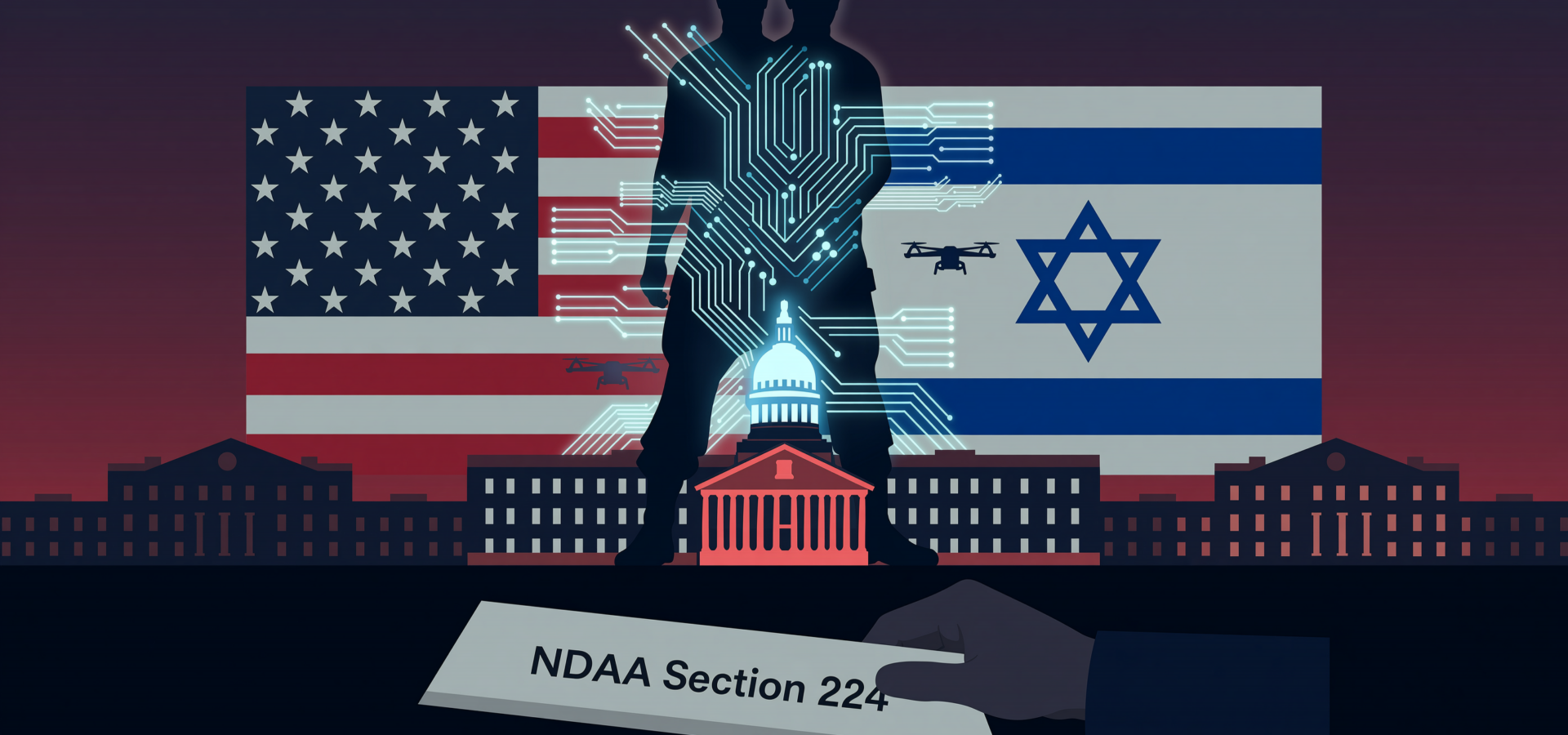
Amid widespread and growing public opposition to the Israeli genocide of Gaza and South Lebanon, a controversial new bill seeks to formally integrate the U.S. and Israeli militaries like never before, making it difficult to tell where one ends and the other begins.
Section 224 of the 2027 National Defense Authorization Act (NDAA) proposes to join the two forces together at the hip, laying the groundwork for extensive cooperation into “seemingly every manner of U.S.-Israeli military-industrial complex cooperation,” according to the Institute for Responsible Statecraft.
This includes the research, development, and production of modern, hi-tech arms, artificial intelligence, biotechnology, drones, directed energy, cyber, and autonomous weapons systems. It would compel the United States to integrate Israeli arms and technologies into its defense supply chain, and fuse the countries’ data capturing and storage facilities together, meaning that Israel could have access to essentially all the U.S. military’s data.
The bill also requires the creation of a new position within the Department of Defense: an executive agent whose role is to coordinate cooperation and integration between the two parties.
In essence, then, it would dramatically change the relationship between the two states, from one where Washington supplies Tel Aviv with money, weapons, and diplomatic support, to a situation where the two are fundamentally intertwined.
It would also make the relationship far less transparent, as aid to Israel currently requires an annual public debate and vote. However, by moving it away from the political realm into that of defense acquisition, oversight and accountability mechanisms will be removed, and the public will have little right to know the details going forward.
Judging by its sponsors, Section 224 has strong support on Capitol Hill. It was put forward by Mike Rogers (R-AL), Chairman of the House Armed Services Committee, and Adam Smith (D-WA), the panel’s highest-ranking Democrat. It is surely, therefore, a formality that it will pass the House Armed Services Committee, before being taken to Congress and the Senate.
Analysts have noted that, if passed, the bill will “extraordinarily” expand Israeli influence in domestic American politics, giving Tel Aviv the opportunity to pull powerful political levers through the tried and tested method of offering jobs. As the Institute for Responsible Statecraft warn, by expanding or starting new arms production facilities like they already have in Mississippi and Arkansas, the Israeli government could use the influence of bringing jobs to districts to buy the support of American members of Congress.
The news that a new bill could essentially fuse together the U.S. and Israeli militaries has been met with pushback online, but provoked little comment in Washington, D.C. One lawmaker who has spoken up in Kentucky Congressman Thomas Massie. “If the provision in the NDAA to integrate/synchronize the U.S. and Israeli militaries (section 224) makes it out of committee, I’ll offer an amendment to strip it from the bill on the floor. We are a sovereign country,” he said on Saturday.
Massie, a strong critic of U.S. support for Israel, recently lost his primary to challenger Ed Gallrein, after AIPAC and other Israel Lobby groups flooded the race with tens of millions of dollars, making it the most expensive contest in American history.
The U.S. already provides Israel with enormous amounts of military aid, having sent hundreds of billions of dollars worth of weapons since 1948. Since 2008, it is required by law to protect Israel’s “qualitative military edge,” by supplying it with advanced weaponry. Section 224, however, would transform and deepen this relationship, making it all-but-impossible to democratically break the U.S.-Israel special relationship.
That alliance is under increased scrutiny, as support for Israel is collapsing across the United States.
A new poll published by Israel’s Institute for National Security Studies found that 60% of Americans (including 75% of respondents under 30 years old) hold a negative view of the country. When asked, a large plurality says that Israel holds too much sway over American politics and politicians.
A 2025 study found that half of American voters believe Israel is carrying out a genocide against its neighbors in West Asia. The International Criminal Court has issued arrest warrants for Israeli prime minister Benjamin Netanyahu and former defense minister Yoav Gallant, among others, on charges of crimes against humanity.
The United States, however, has refused to accept the ICC’s actions, attempted to shut down proceedings, and imposed sanctions on the court. ICC prosecutor Karim Khan stated that Senior U.S. Senator Lindsey Graham – one of Netanyahu’s closest allies in Washington – told him that his court is only “for African thugs like [Russian president Vladimir] Putin. It is not for democracies like Israel and the United States of America.”
The response from the governments of Israel and the United States to the increasing opposition to the genocide has been to crack down on dissent and to censor social media. As Jonathan Greenblatt, CEO of pro-Israel pressure group, the Anti-Defamation League stated, “We really have a TikTok problem, a Gen Z problem.” The Trump administration forced through the sale of TikTok to the family of Larry Ellison, a passionately pro-Israel tech billionaire who is the largest private funder of the Israeli Defense Forces (IDF).
Ellison, no doubt, will support Section 224. Yet the effective merger between the U.S. military and the IDF will have profound consequences for the future of America, and should provoke stiff opposition nationwide. Whether it passes will depend largely on the nature and scale of that opposition.
Alan MacLeod is Senior Staff Writer for MintPress News. He completed his PhD in 2017 and has since authored two acclaimed books: Bad News From Venezuela: Twenty Years of Fake News and Misreporting and Propaganda in the Information Age: Still Manufacturing Consent, as well as a number of academic articles. He has also contributed to FAIR.org, The Guardian, Salon, The Grayzone, Jacobin Magazine, and Common Dreams. Follow Alan on Twitter for more of his work and commentary: @AlanRMacLeod.