

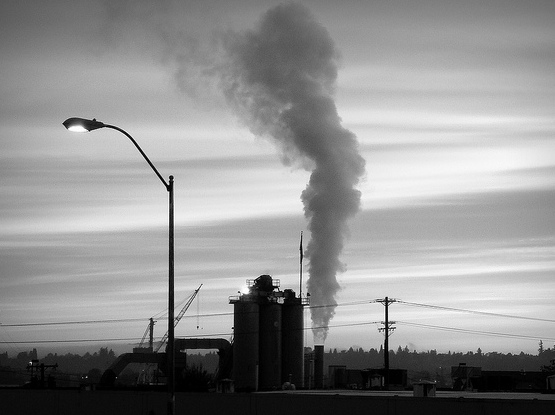
Downwind of the “Industrial Heartland” of Alberta, Canada, where over 40 companies have created the nation’s largest oil, gas and tar sands processing zone, lurk levels of carcinogens and other air pollutants even beyond those of some of the world’s most polluted cities, according to a report published online this week.
In addition, the report in the journalAtmospheric Environment says, the number of men with leukemia and non-Hodgkin lymphoma was higher in communities closest to this “Industrial Heartland” in the Fort Saskatchewan area compared to neighboring communities based on a 13-year record.
The new report, led by scientists at the University of California-Irvine and University of Michigan, comes in the wake of a report by the World Health Organization stating that air pollution causes cancer.
“Our study was designed to test what kinds of concentrations could be encountered on the ground during a random visit downwind of various facilities,” stated Isobel Simpson, lead author of the paper and a UC Irvine chemist. BP, Dow and Shell are among the well-known names operating in the area touted as being “guided by a non profit association of municipalities dedicated to sustainable eco-industrial development.”
“We’re seeing elevated levels of carcinogens and other gases in the same area where we’re seeing excess cancers known to be caused by these chemicals,” stated Simpson.
Among the carcinogens the researchers found in one-minute samples taken in 2008, 2010 and 2012 were 1,3-butadiene and benzene, and the scientists recorded amounts of some dangerous volatile organic compounds (VOCs) 6,000 times higher than normal.
“These levels, found over a broad area, are clearly associated with industrial emissions. They also are evidence of major regulatory gaps in monitoring and controlling such emissions and in public health surveillance,” stated Stuart Batterman, report co-author and a University of Michigan professor of environmental health sciences.
Part of that monitoring and controlling would require transparency from the companies. The researchers found high levels of 1,3-butadiene that could only have come from one facility, but that company had not disclosed those emissions.
While the study looked at the “Industrial Heartland,” the findings offer implications for the many other communities downwind of petrochemical processing operations. “For any community downwind of heavy industrial activity, I would say it’s certainly prudent to conduct surveys of both air quality – especially carcinogens – and human health,” Simpson said.
Though the authors did not point to causal relationship between the pollutants and the cancers, Simpson stated, “Our main point is that it would be good to proactively lower these emissions of known carcinogens. You can study it and study it, but at some point you just have to say, ‘Let’s reduce it.’ ”
This article originally appeared in CommonDreams.