


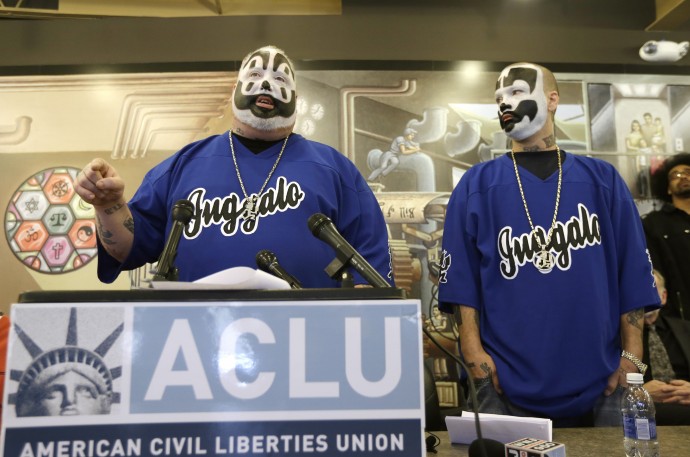
The horror-core-rap duo Insane Clown Posse and four of their devotees — known as “Juggalos” — have filed another lawsuit against the Department of Justice and the FBI after the law enforcement agency listed the group’s fans as gang members in its 2011 National Gang Threat Assessment report.
With the help of the American Civil Liberties Union and two Michigan-based law firms, ICP’s Detroit-based rappers, Violent J and Shaggy 2 Dope, along with Psychopathic Records, filed their most recent lawsuit on Wednesday in an attempt to force the FBI to disclose why it chose to list its fanbase as a gang.
The duo filed a similar lawsuit in 2012, but was unsuccessful. Now that the two have the help of the ACLU, Juggalos will be removed from the FBI’s list of identified gangs, since according to the complaint, “Organized crime is by no means part of the Juggalo culture.
“The ACLU and Miller Canfield both think that the discrimination, profiling and harassment that Juggalos have been facing over the last few years in flat out wrong and un-American, so now they will be helping us fight our case in court,” ICP wrote on its website.
“We are a family,” the group said. “We come together for our luv (sic) of the Insane Clown Posse, Psychopathic Records and our Juggalo pride. Can we take a fuckin’ second to note that Jimmy Buffett’s Parrot Heads, Lady Gaga’s Little Monsters, Justin Bieber’s Beliebers, the Grateful Dead’s Deadheads and many more haven’t been labeled as a gang?”
Listed as a hybrid gang, or a non-traditional gang with multiple affiliations due to a diverse membership, the FBI said in 2011 that hybrid gangs are present in at least 25 states and tend to adopt similar characteristics of larger urban gangs.
“Like most street gangs, hybrid gang members commit a multitude of street and violent crime,” the FBI report said, adding that law enforcement officials in at least 21 states have identified criminal Juggalo sub-sets.
Currently four states — Arizona, California, Pennsylvania and Utah — classify Juggalos as gangs, reasoning that members exhibit gang-like behavior and engage in criminal activity and violence such as simple assault, personal drug use and possession, petty theft, child endangerment and vandalism.
But other than a few isolated arrests, the group says its fans are not involved in criminal activity and were upset that the FBI broadly categorized its entire fan group in a negative light.
“We don’t fit in anywhere,” said Violent J, whose real name is Joseph Bruce. “And when people don’t understand you, people fear you. All we’re trying to do is be like the Stephen King of music. We like to tell horror stories.”
Although he says he first thought that the FBI’s classification of Juggalos as a gang was a compliment, saying he didn’t realize that ICP’s fans “are that heard-of and that renowned.” However, he added that when he realized what was happening to the fans, he realized the group had to do something about it.
“We don’t know if we can beat the FBI,” Violent J said. “But we’re damn sure not gonna sit there and accept it.”
The FBI has until March to respond to the lawsuit. Whether they will remove ICP’s fanbase from the list of known gangs remains to be seen. And if they do, Saura Sahu, an attorney assisting the ACLU of Michigan in ICP’s case, said it won’t be a large defeat for the agency since the FBI had the impact they wanted.
“They scared people away from attending concerts and from affiliating together for the purpose of listening to music,” he said.
Michael J. Steinberg, ACLU of Michigan legal director, agreed the FBI was out of line.
“The Juggalos are fighting for the basic American right to freely express who they are, to gather and share their appreciation of music, and to discuss issues that are important to them without fear of being unfairly targeted and harassed by police.
“Branding hundreds of thousands of music fans as gang members based on the acts of a few individuals defies logic and violates our most cherished of constitutional rights,” Steinberg said.