

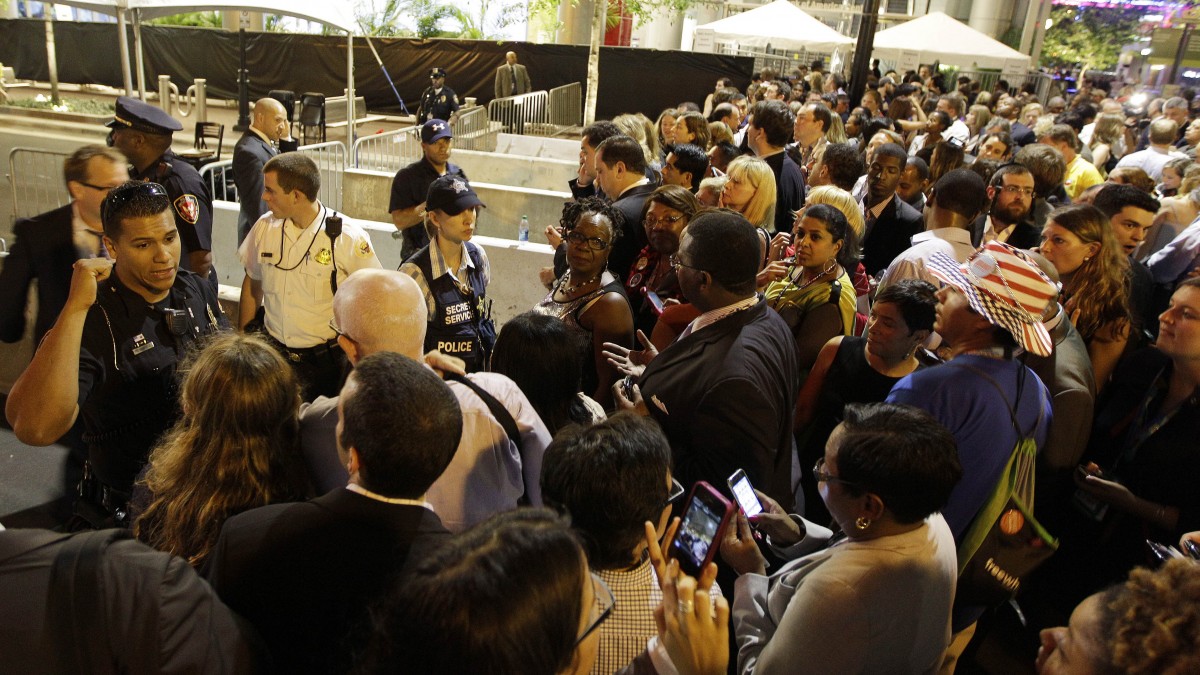

(MintPress) — James Ian Tyson, a North Carolina resident, was recently detained for questioning after he attended a peaceful protest outside the Democratic National Convention in Charlotte. Tyson, was found to be on a “terrorist watchlist” despite only participating in peaceful protests during his work as an activist. Members of the Identity Project, a legal rights group, contend that Tyson’s detention is a violation of his civil liberties, indicative of an erosion in freedoms and First Amendment rights across the U.S.
Legal experts believe the terrorist watchlist could be a way to stifle First Amendment rights to free speech. If used selectively, even in cases not involving terrorist activity, authorities can unlawfully arrest demonstrators and shut down protests critical of government policies.
Terrorist watchlist
After his release from prison last week, Tyson said he was “shocked” to hear that he was on a terrorist watchlist in an interview with the Charlotte Observer.
“I haven’t done anything remotely criminal involving politics. No one knows how you get on this list … or the accountability process or, most importantly, how they get off this list…. I am a local Charlottean and an activist and I believe this is an attempt to stifle my First Amendment rights and keep my voice from being heard.”
Tyson, who describes himself as a carpenter with a veggie farm, admits that he has a few minor offenses on his record, including driving while under the influence. However, the activist has never been involved in any terrorist activity.
The 27-year-old, who has been active in political demonstrations around the Charlotte area, was arrested for driving with a suspended license. After he was arrested, the activist was placed in prison on $10,000 bail, which was described as an “exceptionally high bail” by CNN reporter Ted Metzger.
At the bail hearing, the arresting officer was asked why he feels Tyson is a risk. The officer responded, saying Tyson is a “known activist and protester who is currently on a terrorist watchlist. Request he be held due to DNC being a National Special Security Event.”
Only a few of the estimated 1,000 protesters were arrested at the Democratic National Convention. However, Tyson was the only one held because he was on a “terrorist” watchlist. The list is not published and those placed on the list have no way of finding out whether they have been listed as a terrorist until they are detained.
The list has become quite extensive by some estimates. In 2008, the American Civil Liberties Union published a report stating that the terrorist watchlist, a product of the Bush administration, had surpassed “1 million records.” The ACLU experts believe this equates to about 400,000 people recorded on the secretive list.
At times, well known figures have brought attention to the clandestine classifications. In 2004 Yusuf Islam, the musician formerly known as “Cat Stevens,” was detained while trying to board a flight leaving the U.S. Islam was detained by the Department of Homeland Security because of unspecified ties to a terrorist organization but was later released without being charged.
In Tyson’s case, legal experts believe that the unwarranted “terrorist” title could have been used as a means to silence political speech. Jason Huber, a professor at Charlotte School of Law believes:
“The question is whether or not the stop and the arrest and the attempt to get an unreasonably high bond amount was really a pretext for a police officer’s selective motivation to censor an individual’s political activity. If that’s the case, then you’re in First Amendment territory.”
Tyson, who is most often involved in activities to save to rainforest, maintains his innocence, commenting in a public statement upon his release from prison, “I have done nothing wrong and have nothing to hide. I believe this is an attempt to stifle my First Amendment rights and keep my voice from being heard.”
Americans from divergent political causes believe that Tyson’s case is indicative of eroding political freedoms in the U.S. Previously, members of Occupy Wall Street and libertarian groups have worked collaboratively to challenge other legislation permitting the arbitrary detention of U.S. citizens without charge.
In what most are calling another example of eroding civil liberties, the National Defense Authorization Act (NDAA) has come under attack for the indefinite detention provision, permitting authorities to detain a suspect without charge or due process if he or she is suspected of having ties to a terrorist organization.
Challenging NDAA, “stop-and-frisk,” and the assault on civil liberties
On Wednesday, a New York federal judge permanently blocked the “Homeland Battlefield” bill, a provision of the National Defense Authorization Act (NDAA) allowing the military to detain any U.S. citizen “substantially supporting” a terrorist organization at home or abroad.
Judge Katherine Forrest upheld previous rulings, stating, “First Amendment rights have already been harmed and will be harmed by the prospect of (the law) being enforced. The public has a strong and undoubted interest in the clear preservation of First and Fifth Amendment rights.”
Chris Hedges, former New York Times columnist and key plaintiff in the case, believes that the NDAA, if left unchallenged represented, would be “a totalitarian credo of endless war waged against enemies within ‘the homeland’ as well as those abroad.”
Similarly, many have decried the New York Police Department’s use of stop-and-frisk policies, allowing officers to stop and search any pedestrian without probably cause. While Mayor Michael Bloomberg and Police Commissioner Raymond Kelly continue to support the policy, many New Yorkers have opposed the practice, claiming stop-and-frisk undermines the rights of New Yorkers, particularly those from minority communities.
In June, 50,000 protesters marched down Fifth Avenue in New York City, demanding an end to stop-and-frisk. According to the New York chapter of the ACLU, city residents have been subject to random stops 4 million times since 2004. Young black and Latino residents make up the vast majority of these stops. However, 9 times out of 10, those stopped are found to be innocent according to the legal rights group.